Flux-Cored Wire vs Solid Wire: Which Should You Use?
Quick answer
Use solid wire with shielding gas for clean indoor work, thin material, and minimal slag. Use self-shielded flux-cored wire for outdoor repairs, drafty work, and thicker steel when the machine, polarity, wire data sheet, PPE, ventilation, and slag-removal plan fit the job.
Common questions
- Is flux-cored wire stronger than solid wire?
- Not by default. Strength depends on the specific electrode classification, base metal, procedure, shielding, joint prep, and inspection requirements. Match the wire data sheet to the job rather than choosing by process name alone.
- Can self-shielded flux-cored wire be used with gas?
- Do not assume so. Some flux-cored wires are designed for gas shielding and some are self-shielded. Follow the manufacturer's data sheet for shielding gas, polarity, and parameters.
Source note: Reviewed July 2026 against AWS flux-cored arc welding guidance, Miller process guidance, Lincoln flux-cored electrode guidance, and OSHA welding safety requirements. Wire data sheets, qualified procedures, and applicable welding codes control critical work.
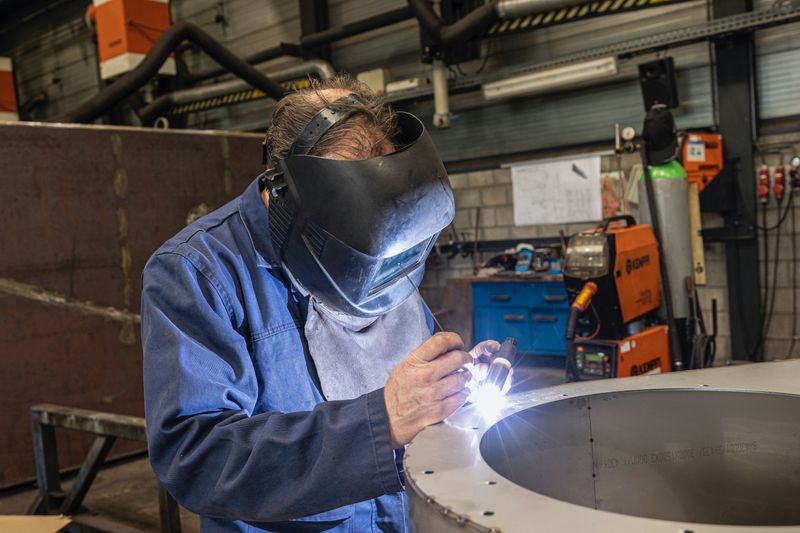
Flux-Cored Wire vs Solid Wire: Which Should You Use?
One of the most common wire-feed questions is whether to run solid wire with shielding gas or flux-cored wire. The useful answer starts with the job conditions: indoor or outdoor, clean or rusty material, thin sheet or heavy plate, available gas, machine output, polarity, required appearance, and whether the weld needs qualified procedure control.
This guide breaks down the differences so you can make the right choice for every project.
Quick Decision Framework
| Constraint | Lean solid wire (GMAW) | Lean self-shielded flux-cored (FCAW-S) | Lean gas-shielded flux-cored (FCAW-G) |
|---|---|---|---|
| Wind or field work | Poor fit unless shielded from drafts | Strong fit | Usually poor fit outdoors because it still uses gas |
| Thin sheet under 1/8 inch | Usually easiest to control | Easy to burn through if settings are high | Possible but not usually the first choice |
| Dirty, rusty, or painted steel | Clean first or expect porosity | More tolerant, still clean what you can | More tolerant than solid wire, but still procedure-dependent |
| Weld appearance | Cleanest bead and least slag | More spatter and slag cleanup | Better appearance than FCAW-S on many shop jobs |
| Productivity on thick steel | Good with enough machine | Good | Often strongest shop-production fit |
| Upfront equipment | Requires cylinder, regulator, hose | No gas hardware | Requires gas hardware and wire data-sheet discipline |
| Skill/risk | Easier to see puddle | Slag can hide defects until chipped | Good production process but not a casual shortcut |
Skip hobby-level trial-and-error when the weld is structural, load-bearing, vehicle-related, pressure-containing, fall-protection-related, or otherwise life-safety critical. Those jobs require a qualified procedure, proper filler metal, competent welding, and inspection beyond this guide.
AWS describes FCAW as having both gas-shielded and self-shielded forms in its flux-cored arc welding overview. Miller’s solid-wire vs. flux-cored guide makes the same practical split: self-shielded flux-cored wire is portable because it does not need an external gas cylinder, while solid wire depends on gas coverage.
What Is Solid Wire?
Solid MIG wire is exactly what it sounds like — a continuous, solid metal wire that serves as both the electrode and the filler metal. It requires an external shielding gas (typically 75% Argon / 25% CO2 for mild steel) to protect the weld pool from atmospheric contamination.
The most common solid wire for mild steel is ER70S-6, which contains deoxidizers (silicon and manganese) that help produce clean welds on slightly rusty or dirty steel.
What Is Flux-Cored Wire?
Flux-cored wire has a hollow outer metal sheath filled with flux compounds. When the wire melts during welding, the flux burns and creates both a shielding gas and a slag covering over the weld bead.
There are two types of flux-cored wire:
- Self-shielded (FCAW-S) — The flux generates all necessary shielding gas. No external gas cylinder required. Common designations include E71T-GS and E71T-11.
- Gas-shielded (FCAW-G) — The flux supplements external shielding gas for superior weld quality. Common designations include E71T-1 and E70T-1.
Head-to-Head Comparison
| Feature | Solid Wire (GMAW) | Flux-Cored (FCAW-S) | Flux-Cored (FCAW-G) |
|---|---|---|---|
| Shielding gas required | Yes | No | Yes |
| Outdoor performance | Poor (wind blows gas away) | Excellent | Moderate |
| Weld appearance | Clean, minimal spatter | More spatter, slag to remove | Good, less spatter than FCAW-S |
| Penetration | Moderate | Deep | Deep |
| Thin material (< 1/8”) | Excellent | Moderate | Good |
| Thick material (> 3/16”) | Moderate | Excellent | Excellent |
| Deposition rate | Moderate | High | Very high |
| Equipment cost | Higher (needs gas setup) | Lower (no gas needed) | Higher |
| Wire cost per pound | Lower | Higher | Higher |
| Slag removal | None | Required | Required |
| Skill level | Beginner-friendly | Moderate | Moderate |
Advantages of Solid Wire
Cleaner Welds
Solid wire with proper shielding gas produces clean, spatter-free welds that require little to no post-weld cleanup. There is no slag to chip, making it ideal for visible welds and production work where appearance matters.
Better on Thin Material
The softer arc characteristics of solid wire make it easier to weld thin sheet metal (18 gauge and below) without burn-through. The precise heat control is especially valuable for automotive body work and HVAC ducting.
Lower Wire Cost
Solid wire typically costs $3-5 per pound less than flux-cored wire. For high-volume production, this difference adds up significantly over time.
Easier for Beginners
The smooth arc and lack of slag make solid wire more forgiving for new welders. You can see the weld pool clearly without a slag covering, which helps develop proper technique.
Recommended Solid Wire Products
- Lincoln Electric L56 ER70S-6 — Excellent all-around mild steel wire with good feedability.
- Hobart H305406-R18 ER70S-6 — Consistent quality at a competitive price.
Advantages of Flux-Cored Wire
Works Outdoors
This is the single biggest advantage of self-shielded flux-cored wire. Wind that would blow shielding gas away from a solid wire weld has no effect on FCAW-S because the shielding is generated internally. This makes it the go-to choice for:
- Field repairs on fences, gates, and farm equipment
- Outdoor structural welding
- Shipyard and bridge construction
- Remote locations where gas cylinders are impractical
Deeper Penetration
Flux-cored wire penetrates deeper than solid wire at the same amperage. The flux core creates a more focused, aggressive arc that drives heat into the base metal. This is especially beneficial for:
- Thick structural steel (3/8” and above)
- Welding through light rust and mill scale
- Single-pass fillet welds on heavy plate
Higher Deposition Rate
The tubular construction of flux-cored wire allows higher current densities, resulting in faster deposition. Gas-shielded FCAW-G can deposit up to 12 pounds per hour compared to roughly 8 pounds per hour for solid wire MIG. This translates to faster completion times on heavy fabrication.
More Forgiving on Dirty Metal
The flux compounds in the core act as deoxidizers and scavengers, absorbing rust, mill scale, and other surface contaminants that would cause porosity in solid wire welds. While you should always clean your metal, flux-cored wire handles imperfect prep better than solid wire.
Recommended Flux-Cored Wire Products
- Lincoln Electric NR-211-MP — The most popular self-shielded flux-cored wire for general-purpose welding.
- Hobart H222106-R19 — Great for outdoor applications and farm repairs.
Polarity Requirements
This is a critical setup detail that trips up many welders:
- Solid wire (GMAW) — Use DCEP (reverse polarity). Wire is positive, work clamp is negative.
- Self-shielded flux-cored (FCAW-S) — Use DCEN (straight polarity). Wire is negative, work clamp is positive.
- Gas-shielded flux-cored (FCAW-G) — Use DCEP (reverse polarity). Same as solid wire.
Always check the wire manufacturer’s data sheet. Running the wrong polarity produces a harsh, erratic arc with excessive spatter and poor penetration.
Wire Selection Worksheet
Before loading a spool, write down the assumptions:
| Field note | What to record | Why it matters |
|---|---|---|
| Base metal | Mild steel, stainless, galvanized, unknown coating | Coatings and alloy affect fumes, prep, and filler choice |
| Thickness | Gauge or measured thickness | Prevents using a hot process on thin sheet |
| Position | Flat, horizontal, vertical, overhead | Some wires are not all-position |
| Environment | Indoor, outdoor, fan nearby, drafty doorway | Determines whether gas shielding is reliable |
| Machine output | Amps, voltage range, duty cycle, wire diameter capacity | Prevents buying wire the machine cannot run well |
| Polarity | DCEP or DCEN per wire label | Wrong polarity causes immediate quality problems |
| Shielding gas | None, CO2, argon/CO2 blend, required flow | Data sheet controls FCAW-G and GMAW setup |
| Cleanup allowance | Slag removal, spatter cleanup, grinding limits | A cheap wire can become expensive in labor |
| Approval level | Practice, repair, production, code-critical | Critical welds need qualified procedures and inspection |
Lincoln’s self-shielded vs. gas-shielded flux-cored electrode guidance is useful when deciding whether portability or shop-production consistency matters more. Pair that with the actual wire data sheet for polarity, gas, stickout, and parameter ranges.
Cost Comparison
While flux-cored wire costs more per pound, the total cost of welding involves more than just wire price:
Solid Wire Total Costs
- Wire: $4-6/lb
- Shielding gas: $30-50 per cylinder refill (lasts 2-4 hours of continuous welding)
- Gas regulator: $50-100 (one-time purchase)
- No slag removal labor
Flux-Cored (FCAW-S) Total Costs
- Wire: $7-12/lb
- No gas required
- No regulator needed
- Slag removal labor: 5-10 minutes per foot of weld
For occasional hobby welding, flux-cored wire may actually be cheaper because you avoid the upfront cost of a gas setup. For production work, solid wire with gas is typically more economical.
When to Use Solid Wire
- You are welding indoors on clean material
- You are working on thin sheet metal (below 1/8”)
- Weld appearance matters (automotive, furniture, art)
- You want minimal post-weld cleanup
- You weld frequently and can justify the gas setup cost
When to Use Flux-Cored Wire
- You are welding outdoors or in drafty conditions
- You are working on thick structural steel
- The material has surface rust or mill scale you cannot fully remove
- You need high deposition rates for productivity
- You are doing field repairs without access to gas
Can You Use Both?
Absolutely. Many welders keep both types on hand. Use solid wire for indoor shop work on clean material, and switch to flux-cored for outdoor projects or thick steel. Most MIG welders handle both wire types — just remember to switch polarity when you change wires.
A multi-process machine that clearly supports polarity changes makes switching between wire types easier, but the machine still has to match the wire diameter, output range, and duty cycle.
Final Thoughts
Neither solid wire nor flux-cored wire is universally better. The right choice depends on your working environment, material condition, and project requirements. When in doubt, match your wire to your conditions: solid wire for clean, controlled indoor work, and flux-cored wire for the real world of outdoor welding and heavy fabrication.
Related Articles
Your gas choice matters as much as your wire choice for MIG welding. The shielding gases guide explains how different argon/CO2 blends affect penetration, spatter, and transfer mode. Setting up your machine correctly for whichever wire you choose is critical — the MIG welder setup guide covers polarity switching, voltage settings, and wire feed speed calibration. If you are doing outdoor or field work where self-shielded flux-cored wire excels, see best portable welders for field work for machine recommendations.
Choose wire with gas, settings, and safety controls in view
These related guides connect wire choice to shielding gas, machine setup, process selection, and field-work equipment.
- Understanding shielding gases
Compare gas requirements before choosing solid wire or gas-shielded flux-cored wire.
- How to set up a MIG welder
Check polarity, wire feed, voltage, gas flow, and test beads after loading wire.
- MIG vs. TIG vs. stick
Confirm wire-feed welding is the right process before narrowing wire type.
- Portable welders for field work
Compare machines when self-shielded flux-cored wire is part of a mobile repair setup.
- Welding cost calculator
Compare wire, gas, cleanup, and labor assumptions before pricing a job.
- Welding equipment maintenance log
Record liner, tip, drive-roll, gas, and cleanup issues that can change wire performance.

The Welder's Guide Editorial Team
Independent trade-focused editorial team