Structural Welding in Construction: Processes, Codes, and Careers
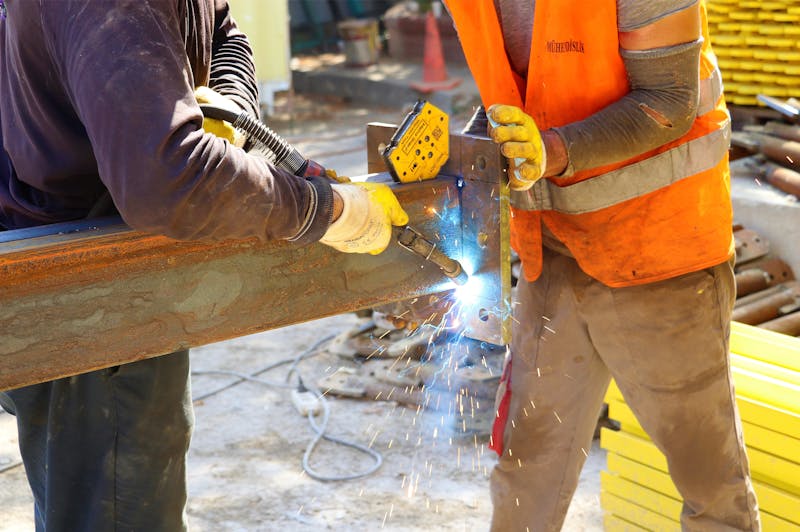
Structural Welding in Construction: Processes, Codes, and Careers
Structural welding is the backbone of modern construction. Every high-rise office building, stadium, bridge, industrial plant, and parking garage relies on welded connections to maintain structural integrity under design loads, wind, seismic forces, and the daily stresses of use. Structural welders work alongside ironworkers and general contractors to make these connections, and the quality of their work directly affects public safety.
This guide covers what structural welding involves, the processes and codes that govern it, and what a career in structural welding looks like.
What Structural Welding Covers
Structural welding encompasses any welded connection in a load-bearing structure:
- Column splices — Connecting vertical steel columns at story-height intervals
- Beam-to-column connections — Joining horizontal beams to vertical columns, often with moment connections designed to resist lateral forces
- Gusset plates and base plates — Distributing loads at connection points
- Stud welding — Attaching shear studs to beam flanges for composite deck construction
- Miscellaneous metals — Handrails, stairs, embeds, pipe sleeves
Governing Code: AWS D1.1
AWS D1.1 (Structural Welding Code — Steel) is the primary code governing structural steel welding in construction. Published by the American Welding Society, it specifies:
- Prequalified joint designs — Groove weld and fillet weld configurations that are pre-approved without procedure qualification testing, provided specific geometry requirements are met.
- Welding procedure specifications (WPS) — Written procedures defining process, filler metal, preheat, interpass temperature, and other essential variables.
- Welder performance qualification — Testing requirements to certify welders for specific positions and joint types.
- Inspection requirements — Visual inspection criteria, nondestructive testing (NDT) requirements by connection type.
- Acceptance criteria — Quantitative limits for undercut, porosity, cracks, and other weld discontinuities.
Most structural steel connections on commercial and industrial projects are designed and inspected to AWS D1.1. Welders on these projects must hold current D1.1 performance qualifications.
AISC Standards
The American Institute of Steel Construction (AISC) publishes design standards for structural steel construction, most notably:
- AISC 360 (Specification for Structural Steel Buildings)
- AISC 341 (Seismic Provisions for Structural Steel Buildings)
AISC 341 is particularly important for construction in seismic zones. Moment frame connections designed for seismic resistance require special pre-qualified connection types (AISC Pre-Qualified Connection Standard, AISC 358) and more stringent weld quality requirements including ultrasonic testing of complete joint penetration (CJP) groove welds.
Welding Processes Used in Structural Construction
FCAW — Flux-Cored Arc Welding
FCAW is the dominant process in structural steel field welding. Its advantages for construction:
- High deposition rate — FCAW deposits weld metal faster than SMAW, increasing productivity in repetitive connections.
- Works in all positions — Gas-shielded FCAW (FCAW-G) with E71T-1 or similar wire works in all positions.
- Tolerates field conditions — Self-shielded FCAW (FCAW-S) with E71T-8 or similar wire does not require external shielding gas, making it viable in windy field conditions.
- Semi-automatic process — Lower skill demand than SMAW for production work.
Limitations: FCAW produces more fume than GMAW; requires fume extraction or outdoor use. Self-shielded flux-core is not acceptable for all joint types (check WPS requirements).
Common FCAW consumables in structural welding:
- E71T-1C (gas-shielded, CO2) — All-position, high deposition, smooth bead
- E71T-8 (self-shielded) — Field use without gas, good for vertical up and overhead
- E70T-1 (gas-shielded) — Flat and horizontal positions, high deposition
SMAW — Shielded Metal Arc Welding (Stick)
Despite being older technology, SMAW remains common in structural construction for:
- Access-limited locations — The stick electrode holder needs no external gas or wire feed
- Repair welding — Quick setup for spot repairs
- Root passes — On some groove weld configurations
- Small quantities — When FCAW setup is not justified
Common SMAW electrodes in structural work:
- E7018 — Low hydrogen, all-position, widely used for structural connections
- E7018-1 — Higher ductility version for seismic connections
- E70XX-HZ4 — Low hydrogen meeting diffusible hydrogen requirements of AWS D1.8 (seismic supplement)
GMAW — Gas Metal Arc Welding (MIG)
GMAW (solid wire MIG) is less common in structural field welding than FCAW but is used in:
- Shop fabrication (controlled environment)
- Light structural components
- Stud welding (GMAW stud gun process)
For field work, FCAW generally outperforms GMAW due to wind sensitivity of GMAW shielding.
SAW — Submerged Arc Welding
SAW is used primarily in structural steel fabrication shops for:
- Girder production — Welding web-to-flange fillet welds on plate girders
- Column fabrication — Shop welding of built-up column sections
- High deposition rate applications — SAW can deposit 20–30 lbs/hour (vs. 3–8 lbs/hour for SMAW)
SAW is not practical for field work — it requires a flux hopper, recovery system, and flat position. It is entirely a shop process.
Stud Welding
Shear studs are welded to beam flanges using drawn arc stud welding — a specialized process that uses a pistol-style stud gun to weld headed steel studs in under 1 second. These studs transfer shear forces between the steel beam and concrete slab in composite construction.
The Nelson Stud Welding System is the industry standard for construction stud welding.
Welding Positions and Accessibility in the Field
Structural welding in the field involves all positions:
- Flat (1F/1G): Beam flange welds from above, base plate welds
- Horizontal (2F/2G): Shear tab welds, column web connections
- Vertical (3F/3G): Column splice welds, certain moment connections
- Overhead (4F/4G): Bottom flange welds on connections made from below
Ironworker welders must be qualified in the positions required for their work. A 3G (vertical) and 4G (overhead) qualification covers all groove weld positions; 3F and 4F cover all fillet weld positions.
Connection Types in Structural Welding
Simple Connections
Simple connections (shear connections) transfer vertical load only:
- Shear tabs — Plate welded to column web with field-bolted beam web
- Seated connections — Seat angle or plate welded to column supporting beam end
- Clip angles — Double angles welded to column web
Most simple connections involve fillet welds on shear tabs, which are among the most common structural welds.
Moment Connections
Moment connections transfer both shear and moment (rotational force). They are critical in moment frames designed to resist wind and seismic lateral loads:
- CJP (Complete Joint Penetration) groove welds on beam flanges
- The seismic version (SMF — Special Moment Frame) requires pre-qualified connections per AISC 358 and more rigorous inspection
Moment connection groove welds are among the most inspected and most critical welds in structural construction. Ultrasonic testing (UT) is typically specified.
Inspection Requirements
Visual Inspection (VT)
All structural welds receive visual inspection per AWS D1.1 Table 6.1. Visual inspection checks:
- Weld size and length
- Profile (undercut, overlap, convexity/concavity)
- Surface porosity
- Cracks
- Arc strikes
Non-Destructive Testing (NDT)
Based on connection criticality:
- Magnetic Particle Testing (MT) — Detects surface and near-surface cracks. Common on tension members.
- Ultrasonic Testing (UT) — Detects internal weld defects in CJP groove welds without radiation. Required for most moment connections.
- Radiographic Testing (RT) — X-ray inspection. Less common in field structural work due to access requirements; more common for pipe connections at compressor stations.
Ironworker Welding Careers
Structural welders in union construction work under the International Association of Bridge, Structural, Ornamental and Reinforcing Iron Workers (Iron Workers Union). The Iron Workers are one of the largest building trades unions.
Ironworker apprenticeship:
- 3-year apprenticeship program combining on-the-job training and classroom instruction
- Apprentices learn rigging, connecting (bolting up structural steel), and welding
- Wage progression from 55% to 100% of journeyman scale during apprenticeship
Journeyman ironworker welder wages:
- $28–$65/hour depending on market (New York, San Francisco, and Chicago are the highest)
- Total package with benefits: $45–$90/hour
High-rise construction in major cities offers the highest wages and most interesting structural welding work — welding connections 500 feet in the air, in all weather, with the city spread out below.
Non-Union Structural Welding
Non-union structural steel fabrication shops and field contractors also employ significant numbers of structural welders. Common employers:
- Steel fabrication shops (Nucor Building Systems, BlueScope, commercial fabricators)
- General contractors with in-house structural departments
- Specialty contractors (bridge construction, transmission towers)
Building a Structural Welding Career
Recommended path:
- Complete a welding program at a community college or vocational school
- Obtain AWS D1.1 3G and 4G qualification (covers all positions)
- Apply to an Iron Workers Local apprenticeship or find entry-level work at a structural fabrication shop
- Pursue AWS CWI for inspection and quality assurance career advancement
- Consider AISC certification for specific connection types if targeting seismic markets
Structural welding is demanding work in demanding environments, but it is also among the most visible and permanent work a welder can do. Buildings you weld today may stand for a century.

The Welder's Guide Editorial Team
Independent trade-focused editorial team