Pipe Welding for Beginners: Getting Started with 6G
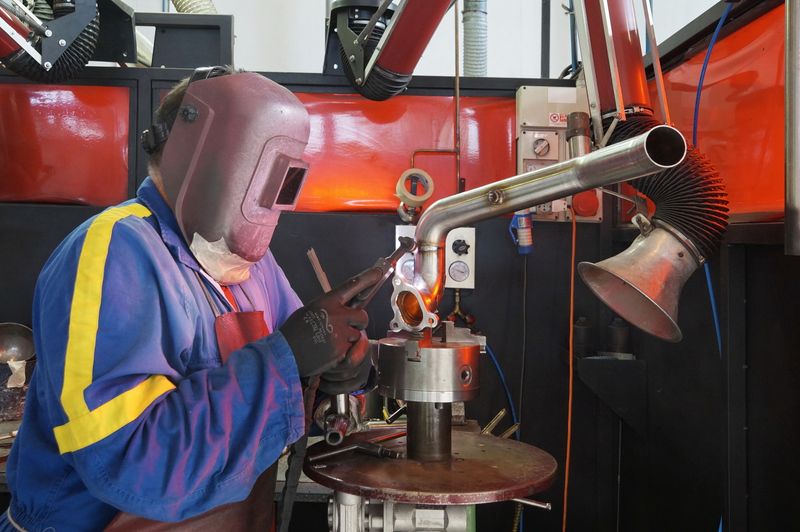
Pipe Welding for Beginners: Getting Started with 6G
Pipe welding is the most sought-after and highest-paid welding specialty in the trade. A certified 6G pipe welder can command $30–$60+ per hour, with top pipeline and industrial welders earning over $100,000 annually. The 6G position — fixed 45-degree incline — is the most demanding pipe welding position because every possible weld position occurs at some point around the pipe circumference.
This guide walks you through the fundamentals of pipe welding and the step-by-step progression from flat plate to 6G certification.
Why Pipe Welding Is Different from Plate Welding
Plate welding is fundamentally the same in every pass — you establish your position and travel in a consistent direction. Pipe welding is different in three key ways:
-
The position changes continuously. As you weld around the circumference, you transition from flat (12 o’clock) through vertical (3 and 9 o’clock) to overhead (6 o’clock) in a single pass. The weld pool behaves differently in each position, and you must adapt your technique continuously.
-
Open root technique. Most structural and code pipe welding requires a single-pass root weld that fully penetrates the pipe wall without a backing ring. This is much more demanding than fillet welds or groove welds with backing.
-
Tight tolerances. Pipe welds are frequently subjected to x-ray or ultrasonic inspection. Internal defects that might be acceptable in structural plate work are rejectable in pipe — there is nowhere to hide.
Tools and Equipment
TIG Welder
TIG (GTAW) is the standard process for pipe root passes in critical applications (petrochemical, power generation, food service, pharmaceutical). Some applications allow stick root passes. For learning, TIG is the superior choice — it gives you complete control over the weld pool.
A machine with 150–200A output is sufficient for most pipe work. Foot pedal control is standard for TIG pipe welding.
Filler Rod
- ER70S-2 — Standard carbon steel pipe filler. Triple-deoxidized for excellent root pass quality.
- ER308L — For 304/304L stainless pipe
- ER316L — For 316/316L stainless pipe
Tungsten
- 2% Lanthanated (gold band) — Works on DC for carbon steel and stainless pipe
- 2% Thoriated (red band) — Traditional choice, still widely used
Pipe Beveling and Fitup
For open root pipe welding, joint preparation is critical:
- Bevel angle: 37.5° (75° included angle)
- Root face: 1/16” (land)
- Root gap: 3/32”–1/8”
Consistent, accurate fitup determines whether you can achieve an acceptable root bead. Use pipe beveling tools and consistent clamps.
The Mathey Dearman pipe clamp holds pipe during fitup and tacking.
The Progression: 1G to 6G
Pipe welding certification tests are defined by positions:
| Position | Pipe Orientation | Description |
|---|---|---|
| 1G | Horizontal (rotated) | Pipe rotates — welder stays flat |
| 2G | Vertical | Pipe vertical, weld horizontal |
| 5G | Horizontal (fixed) | Pipe horizontal, welder travels around |
| 6G | 45° incline (fixed) | Most demanding — all positions covered |
Progression for learning:
- Master flat plate in all positions first
- Move to 2G pipe (vertical fixed) — horizontal welding around a vertical pipe
- Progress to 5G (horizontal fixed) — all positions without pipe rotation
- Finally, 6G (45° fixed) — the certification standard
A 6G certification is the most valued because it qualifies the welder for all pipe positions. Most employers accept 6G certification as evidence of competence for any pipe position work.
The Open Root Technique
The open root is what separates pipe welding from plate welding. The root pass must:
- Fully fuse both pipe bevels at the root
- Produce a smooth, consistent internal bead (the root bead visible inside the pipe)
- Achieve complete penetration without voids, cold lap, or excess penetration (icicles)
Setting Up the Root Pass
- Clean the bevel faces with a clean stainless steel brush and acetone.
- Set your root gap to 3/32”–1/8” consistently around the circumference. Use gap spacers or coins as gauges.
- Tack weld at 3, 6, 9, and 12 o’clock positions. Tacks must achieve the same penetration as the root bead — a low-quality tack is an internal defect waiting to be found by x-ray.
- Check inside the pipe after tacking — the root should be flush and consistent at each tack location.
Root Pass Technique
The root pass requires steady, slow travel with enough amperage to achieve full penetration without burning through.
Settings (2-inch schedule 40 carbon steel pipe):
- Tungsten: 3/32” 2% Lanthanated, sharp point
- Filler: ER70S-2, 1/16” diameter
- Amperage: 65–90A with foot pedal
- Gas: 100% argon, 15–20 CFH
- Cup: #6–#8
Technique:
- Hold the tungsten 1/8” from the root gap
- Feed filler rod into the leading edge of the puddle from the high side
- Use a slight “keyhole” technique — the root gap should appear as a small keyhole ahead of the puddle as penetration is achieved
- Travel speed is slow — slower than plate work to achieve full penetration
- Tilt the torch 5–10 degrees in the direction of travel
At position changes:
- 12 o’clock (flat): Standard technique, gravity helps contain the puddle
- 3/9 o’clock (vertical): Use a slight uphill motion, reduce amperage slightly
- 6 o’clock (overhead): Most challenging. Reduce amperage further, maintain a tight arc, and keep the puddle small
Walking the Cup
“Walking the cup” is a technique used primarily for fill and cap passes on larger pipe (typically 3”+ diameter). Instead of freehand guiding the torch, the edge of the TIG cup (gas nozzle) is rested against the pipe and “walked” along the bevel by rocking and rolling the cup.
This technique provides:
- Consistent torch angle
- Stable arc length
- Consistent travel speed
- Reduced hand fatigue on large-diameter pipe
How to Walk the Cup
- Use a larger TIG cup (#8–#12) that can rest solidly on the pipe bevel.
- Place the edge of the cup on one wall of the bevel.
- Rock the cup by pivoting on its edge — this moves the arc side to side across the joint while progressing forward.
- Feed filler rod in a consistent rhythm, timing filler additions to each end of the rocking motion.
Walking the cup takes significant practice to master. Start on scrap pipe and develop the rhythm before attempting certification-quality welds.
Fill and Cap Passes
After the root pass:
- Inspect the root — look inside the pipe. The root bead should have a consistent, slightly raised profile on the inside. Reject and repair any voids, cold lap, or high-low at tacks.
- Hot pass — immediately after the root on carbon steel, run a hot pass while the root is still warm. This burns out any trapped slag from the root and improves fusion.
- Fill passes — subsequent passes build up the groove to near-flush. Use stringer beads or slight weave. Maintain interpass temperatures and remove slag completely between each pass.
- Cap pass — the final pass must be flush to slightly convex (no more than 1/8” crown) with good fusion at the toes. The cap appearance is the most visible indicator of welder quality.
Back Purging Stainless Pipe
When TIG welding stainless steel pipe, the inside of the pipe must be purged with argon to prevent sugar (oxide formation on the backside of the root bead). Sugaring destroys the corrosion resistance of the stainless at the root.
- Seal the ends of the pipe with purge dams (tape or dedicated purge plugs).
- Flow argon at 10–15 CFH through an inlet tube in one dam.
- Purge for 2–3 pipe volumes of gas before welding.
- Maintain purge flow throughout root pass and until the weld cools below 400°F.
Equipment for Pipe Welding Practice
Starting a pipe welding practice setup requires:
- Practice pipe coupons — 2-inch Schedule 40 pipe is the standard practice diameter for certification. Beveled coupons can be purchased from welding supply stores. Practice pipe coupons save the time of cutting and beveling.
- Pipe stand — A simple pipe stand holds the practice coupon in the correct position. H&M Pipe Beveling stand serves double duty.
- 5G practice stand — For 5G and 6G practice, the pipe must be fixed at the correct angle. Build a simple stand from square steel tube.
The Path to Certification
AWS D1.1 vs. ASME IX vs. API 1104
Different industries use different pipe welding codes:
- ASME Section IX — Power piping, pressure piping, process piping. Most common for industrial/petrochemical.
- API 1104 — Pipeline welding. Used for oil and gas transmission lines.
- AWS D1.1 — Structural welding (primarily for steel construction, not pipe-specific).
What the Certification Test Involves
- Pre-test qualification — Review the WPS (welding procedure specification) you will follow. The test must be performed per an approved WPS.
- Groove weld test — Weld a pipe coupon in the specified position (typically 6G for full certification).
- Visual inspection — Inspector checks for surface defects.
- Destructive testing — The coupon is sectioned into bend specimens and root/face bend tests are performed. Both must pass.
- Radiographic testing (RT) — X-ray of the completed weld reveals internal defects. This is the most demanding part.
Certification is specific to the process, material, and position tested. A 6G TIG certification on carbon steel does not automatically certify you for stainless or for stick welding.
Training Options
- Community college welding programs — Most offer pipe welding certification prep courses. Typically 1–2 semesters.
- Apprenticeship programs — UA (United Association of Plumbers and Steamfitters) and other unions offer paid apprenticeships that include pipe welding training.
- Private welding schools — Faster tracks (6–12 weeks) to certification for career changers.
The path from plate welding to 6G certification typically takes 6–18 months of consistent practice for welders who are already proficient on plate.
Final Thoughts
Pipe welding is demanding, but the skill and pay ceiling are higher than almost any other welding specialty. Start with the fundamentals — consistent fitup, clean root passes, proper technique — and build position by position. When you earn your 6G certification, you join a relatively small group of welders with access to the highest-paying welding jobs in the industry.

The Welder's Guide Editorial Team
Independent trade-focused editorial team