Marine Welding: Techniques, Materials, and Corrosion Protection
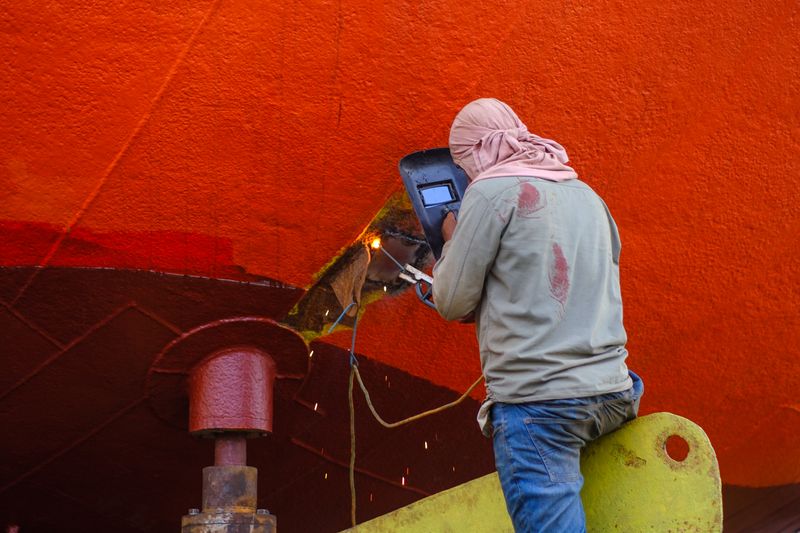
Marine Welding: Techniques, Materials, and Corrosion Protection
Marine welding presents challenges found in no other environment: saltwater corrosion attacks every weld and parent material, thermal cycling from hot sun to cold water stresses joints, and structural failures at sea can be catastrophic. Welding for marine applications requires understanding not just how to make a sound weld, but which materials survive long-term in saltwater environments and how to protect them.
This guide covers the primary marine welding applications, materials, and techniques for both professional shipbuilders and recreational boat fabricators.
Marine Environment: Why It’s Different
Saltwater (and even freshwater with dissolved minerals) attacks metals through:
- Galvanic corrosion — When two dissimilar metals are in electrical contact in saltwater, the less noble metal corrodes rapidly. Stainless steel next to aluminum creates a galvanic couple. Bronze hardware on an aluminum hull will destroy the aluminum around the fasteners.
- Crevice corrosion — In tight crevices (under washers, in lap joints), oxygen-depleted conditions create concentrated attack zones even on otherwise resistant materials.
- Pitting corrosion — Common on stainless steel in low-oxygen conditions (submerged applications). Chloride ions penetrate the passive oxide layer and create deep pits.
- Stress corrosion cracking (SCC) — Tensile stress combined with corrosive environment causes cracking in susceptible materials. High-strength aluminum alloys (7000 series) and some stainless alloys are susceptible.
Understanding these mechanisms guides material selection and design decisions.
Marine Welding Materials
Aluminum — The Primary Marine Hull Material
Aluminum is the dominant material for recreational boat hulls, commercial fishing vessels, workboats, and increasingly for larger vessels. Its advantages:
- Lightweight — Typically 30–40% lighter than equivalent steel construction
- Corrosion resistance — Marine-grade aluminum alloys form a natural oxide layer that resists saltwater
- Weldable — Welded aluminum construction is the industry standard
- No paint required for protection — Though paint is used for antifouling on underwater surfaces
Marine-grade aluminum alloys:
| Alloy | Temper | Best For | Notes |
|---|---|---|---|
| 5083 | H116 | Hull plates, structurals | Best general marine alloy |
| 5086 | H116 | Hull plates | Slightly lower strength than 5083 |
| 5052 | H32 | Interior fittings, lightweight parts | Lower strength but excellent formability |
| 6061 | T6 | Extrusions, masts, spars | Strong, machines well; avoid in hull |
| 6063 | T5/T6 | Railing, framing extrusions | Architectural aluminum |
5083-H116 is the standard for hull plate and structural marine aluminum. It has excellent saltwater corrosion resistance and maintains strength in the welded condition.
Avoid 2000-series and 7000-series aluminum for marine welding. These alloys are susceptible to stress corrosion cracking in saltwater and are not appropriate for hull or structural use.
Welding Aluminum: Process and Technique
Process: TIG (GTAW) with AC for small work and root passes. MIG (GMAW) with pulsed power for production hull work.
Filler metal:
- 5083 base metal → 5183 filler (preferred) or 5356
- 5086 base metal → 5356 filler
- 5052 base metal → 5356 filler
- 6061 base metal → 5356 or 4043 filler (4043 gives better flow but lower strength)
Shielding gas: 100% argon for TIG. 100% argon or Ar/He blend for MIG.
Cleanliness: Aluminum oxide on the surface has a melting point three times that of the base metal. Mechanical cleaning (stainless wire brush, dedicated to aluminum only) and chemical cleaning (acetone wipe) are essential immediately before welding.
Joint distortion: Aluminum has roughly twice the thermal expansion of steel and much lower stiffness when hot. Distortion control requires:
- Balanced weld sequences (alternate sides on panels)
- Prebending panels to compensate for expected distortion
- Rigid fixturing
- Short, alternating stitch sequences on hull panels
Recommended equipment: The Miller Millermatic 252 with a push-pull gun system handles aluminum production MIG welding. Aluminum 5356 MIG wire is the standard marine filler.
Stainless Steel in Marine Applications
Stainless steel is used extensively in marine hardware, rigging fittings, cleats, railings, exhaust components, and sometimes for hull construction on small vessels and commercial fishing boats.
Marine stainless grades:
| Grade | Composition | Application | Notes |
|---|---|---|---|
| 316L | 18Cr-10Ni-2Mo | Hardware, fittings, below waterline | Mo improves pitting resistance |
| 316 | Same, higher C | Above waterline hardware | Good general marine use |
| 304 | 18Cr-8Ni | Above waterline only | Poor below waterline (pitting) |
| 2205 Duplex | 22Cr-5Ni-3Mo | Critical structural, propeller shafts | Superior to 316 in corrosion |
| 904L | High-Mo austenitic | Severe chemical environments | Premium cost |
Use 316L or better for all submerged or frequently wetted components. Grade 304 pits aggressively in submerged saltwater conditions within years.
Welding stainless for marine use:
- TIG (GTAW) is preferred for marine hardware — cleaner welds with less heat input
- ER316L filler for 316/316L base metal
- Back purge all pipe and tube welds to prevent oxidation on the inside surface (sugaring)
- Low heat input — sensitization destroys corrosion resistance in the HAZ
- Post-weld passivation with citric or nitric acid solution restores the passive layer
Steel Hull Welding
For commercial vessels, workboats, and naval vessels, carbon steel (typically ASTM A36 or AH36 marine grade) is the structural material. Steel hulls require corrosion protection through:
- Epoxy primer and antifouling paint systems
- Cathodic protection — sacrificial zinc anodes or impressed current systems
Welding marine steel:
- Process: SMAW, FCAW, and GMAW are all used
- Filler: Match base metal (E70XX for A36, E36XX for AH36)
- Preheat as required by plate thickness (AH36 may require preheat on thicker sections)
- Complete all welds — unfused areas trap water and corrode from the inside out
Hull Construction Techniques
Aluminum Hull Plate Welding
Aluminum hull construction involves:
- Frame setup — Longitudinal stringers and transverse frames are assembled and tacked
- Panel fitting — Aluminum plates are cut, formed (where needed), and fitted to frames
- Tack welding — Plates are tacked every 6–12 inches before full welding
- Full welding sequence — Welding proceeds in a balanced, alternating sequence to minimize distortion
- Stiffener welding — Internal stiffeners are welded after hull plating is complete
Typical weld sizes on recreational aluminum hulls: 3/16” fillet welds on structural connections, 1/8”–3/16” on hull-to-frame connections.
Leak Testing
All hull welds require testing before launch:
- Air test with soap solution — Pressurize the hull slightly and check welds with soapy water
- Water test — Fill compartments and check for leaks
- For commercial vessels, classification society survey may require additional tests
Galvanic Corrosion Prevention in Marine Welding
Isolation of Dissimilar Metals
Never allow aluminum and stainless steel, copper alloys (bronze, brass), or carbon steel to have direct metal-to-metal contact in saltwater. Use:
- Nylon or Delrin isolation bushings and washers at fastener locations
- Paint barrier — minimum two coats of epoxy primer on contacting surfaces
- Tape isolation — Bituminous tape or self-adhesive fairing compound at structural interfaces
Sacrificial Anodes (Zincs)
Zinc anodes protect the overall hull from galvanic attack by providing a sacrificial metal that corrodes preferentially. Anodes must be:
- Welded or bolted to the hull structure at appropriate intervals
- In electrical contact with the hull (no paint between anode and hull)
- Replaced when 50% consumed
Hull-side welded zinc anode plates are common on aluminum vessels. Through-hull bolted anodes on stainless or bronze studs provide galvanic connection.
Impressed Current Cathodic Protection (ICCP)
Larger vessels use ICCP systems — an external power source maintains a protective current on the hull. More complex than sacrificial anodes but more precisely controlled.
Specialty Marine Welding: Stainless Railings and Hardware
Stainless steel railing is among the most visible welding on boats. Quality expectations are high — customers see the welds daily.
Best practice for marine stainless railings:
- TIG weld all visible joints for clean appearance
- Use 316L filler throughout
- Passivate completed railings with citric acid cleaner (Citrisurf 77 passivation solution
- Polish welds to #4 or mirror finish as specified
For tubular railing, back purge all tube joints or use soluble dam purge inserts.
Certifications for Marine Welding
Commercial marine welding (US Coast Guard regulated vessels) may require:
- AWS D1.1 — For structural steel
- ASME Section IX — For pressure vessels and piping on vessels
- ABS Rules for Welding — American Bureau of Shipping classification standards for surveyed vessels
- Lloyd’s Register, DNV GL, Bureau Veritas — International classification societies with their own welding qualification requirements
For high-value or commercial build work, understanding which classification society governs the specific project and qualifying to their rules is essential.
Final Thoughts
Marine welding rewards attention to material selection and corrosion protection as much as welding technique itself. A technically perfect weld in the wrong material, or without proper galvanic isolation, fails long before its time. The combination of good metallurgical practice, proper filler selection, and comprehensive corrosion protection produces marine structures that last decades in demanding conditions.

The Welder's Guide Editorial Team
Independent trade-focused editorial team