How to Reduce Welding Spatter: Causes, Prevention, and Products
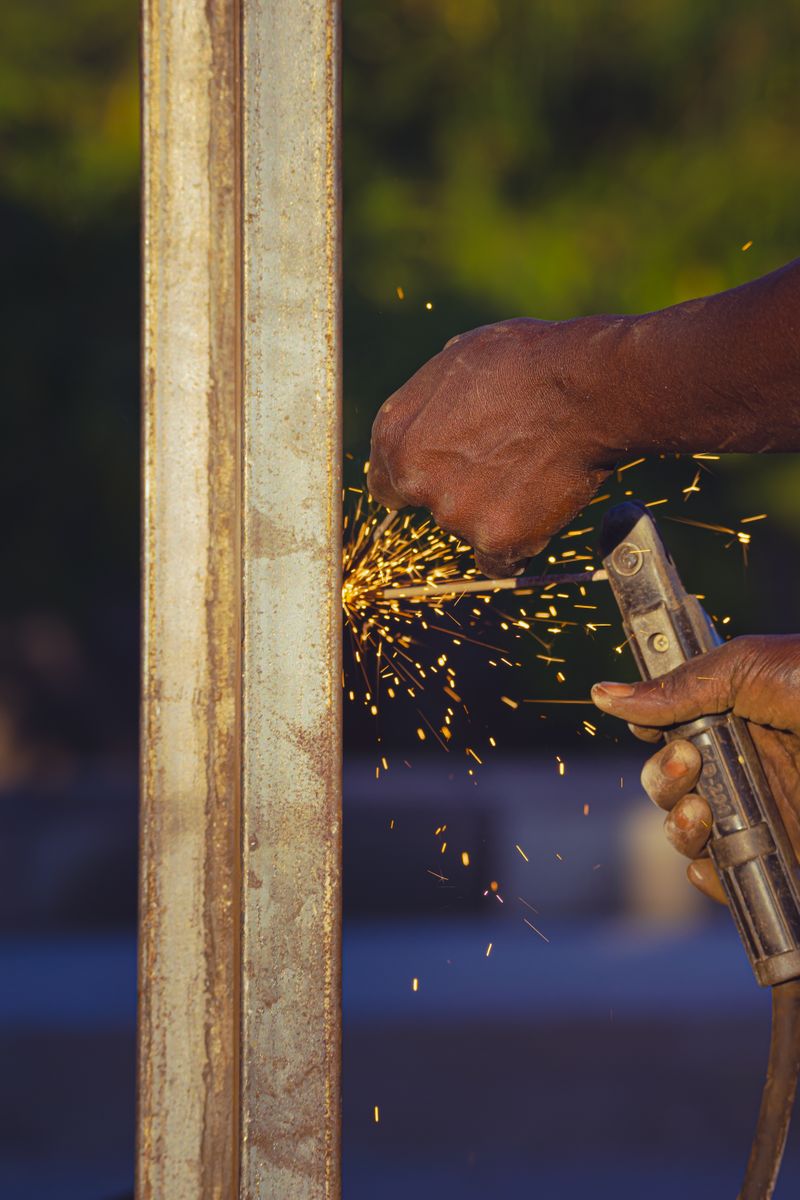
How to Reduce Welding Spatter: Causes, Prevention, and Products
Welding spatter — those small balls of molten metal that fly off the weld pool and stick to the base metal and equipment — is one of the most common welding frustrations. Beyond the annoyance of chipping it off, spatter increases cleanup time, wastes consumables, and can indicate a welding problem that reduces weld quality.
The good news: most spatter has fixable causes. Understanding why it happens is the first step to eliminating it.
Why Welding Spatter Happens
Spatter occurs when molten weld metal is ejected from the weld pool before it can solidify. The primary causes:
1. Incorrect voltage-to-wire-speed ratio (MIG welding)
MIG welding produces a stable arc when voltage and wire feed speed are properly balanced. When voltage is too low for the wire feed speed, the wire “stubs” into the puddle repeatedly — each stubbing event creates a burst of spatter. Conversely, excessive voltage creates an erratic, spattery arc.
2. Wrong gas mixture
High-CO2 content in the shielding gas makes the arc more aggressive and increases spatter. 100% CO2 produces significantly more spatter than 75/25 Ar/CO2. As argon percentage increases (up to 100% for specific applications), spatter decreases.
3. Dirty or contaminated base metal
Oil, rust, mill scale, paint, and moisture disrupt the arc and cause spatter. The arc reacts to contamination by popping and spattering rather than producing a steady, smooth bead.
4. Long arc length (stick out)
In MIG welding, excessive contact-tip-to-work distance (CTWD or “stick out”) reduces effective voltage at the arc and causes stubbing. Optimal stick out is typically 1/2–3/4 inch.
5. Wrong polarity
DCEN (straight polarity) versus DCEP (reverse polarity) produces very different arc characteristics. Most MIG welding uses DCEP. Incorrect polarity selection causes excessive spatter.
6. Using flux-core wire without adjusting settings
Self-shielded flux-core wire and gas-shielded solid wire have different optimal settings. Using settings calibrated for one with the other produces excessive spatter.
7. Travel speed too slow
Slow travel speed allows excessive heat buildup in the weld pool, creating an overly fluid, turbulent puddle that spatters. Maintain a consistent travel speed.
How to Reduce MIG Welding Spatter: Settings
Step 1: Check Your Voltage-Wire Speed Balance
The voltage and wire feed speed relationship is the most common source of spatter in MIG welding.
Signs of too-low voltage relative to wire speed:
- Hissing, crackling, or “machine gun” sound (not the smooth bacon-frying sound)
- Wire visibly stubbing into the puddle
- Heavy, consistent spatter in a ring around the weld
Adjustment: Increase voltage by 0.5–1V increments until the arc sounds smooth.
Signs of too-high voltage:
- Wide, flat bead
- Arc wander
- Light spatter scattered widely
Adjustment: Reduce voltage until the arc tightens and stabilizes.
Step 2: Optimize Your Shielding Gas
For solid wire MIG, the optimal gas for spatter reduction is 75/25 Ar/CO2 (C25). This is the standard recommendation for most MIG applications on carbon steel.
Spatter by gas type (relative):
- 100% CO2: Most spatter
- 75/25 Ar/CO2 (C25): Moderate, standard for most work
- 90/10 Ar/CO2: Less spatter than C25, slightly higher cost
- 98% Ar / 2% CO2: Least spatter (spray arc range), very clean
For automotive, light fabrication, and work where cleanup time matters, 90/10 or richer argon blends pay for themselves in reduced cleanup time.
Step 3: Reduce CTWD (Contact Tip to Work Distance)
Check your stick out. For most solid wire MIG:
- 0.023”–0.030” wire: 1/2-inch CTWD
- 0.030”–0.035” wire: 1/2–3/4-inch CTWD
- 0.045” wire: 3/4–1-inch CTWD
If you have been welding with excessive stick out (1 inch+ on smaller wire), reducing it will immediately reduce spatter.
Step 4: Verify Polarity
For solid wire MIG welding, verify DCEP (electrode positive, work negative). Check that your ground clamp is on the negative terminal and your wire drive/gun is on the positive terminal.
For self-shielded flux-core (FCAW-S), most wires use DCEN (electrode negative). Check your wire manufacturer’s data sheet.
Step 5: Increase Inductance (if available)
Many modern MIG welders include an inductance adjustment. Inductance controls how quickly the current rises during short-circuit events. Higher inductance produces a softer, more stable short-circuit transfer with less spatter. If your machine has this adjustment, try increasing it 1–2 steps.
Technique Adjustments to Reduce Spatter
Clean Your Base Metal
The single most impactful technique change: clean the metal before welding. Mill scale, rust, and especially oil/paint dramatically increase spatter.
- Use an angle grinder with a flap disc to remove mill scale and rust from the weld zone
- Acetone or lacquer thinner to remove oil, grease, and drawing compounds
- Wire brush to remove loose scale before grinding
Maintain Consistent Travel Speed
Consistent travel speed is crucial for consistent heat input and puddle stability. If you vary your speed — pausing to adjust position, then speeding up to catch up — the puddle becomes uneven and spatters more.
Practice moving smoothly and consistently. Use physical rest points (resting your arm on the workbench or a support) to maintain steady motion.
Drag Angle vs. Push Angle
For MIG welding:
- Forehand (push) technique — Gun angled in the direction of travel. Less penetration, less spatter. Good for thin material.
- Backhand (drag) technique — Gun angled back from the direction of travel. More penetration, slightly more spatter. Good for thicker material.
If spatter is a concern and penetration is adequate, switch to a push technique.
Keep the Gun Clean
Spatter inside the nozzle and on the contact tip disrupts gas flow and arc stability:
- Clean the nozzle regularly with welding pliers or nozzle cleaning tools
- Replace contact tips before they wear out — a worn, spattered tip causes arc irregularities
- Anti-spatter nozzle gel: Dip the nozzle in Nozzle Dip anti-spatter gel before each welding session to prevent buildup
Anti-Spatter Products
When some spatter is unavoidable, anti-spatter products make cleanup dramatically faster.
Anti-Spatter Sprays
Anti-spatter spray applied to the base metal surface prevents spatter from bonding. Instead of welding itself to the metal, it lands on the spray film and is easy to remove with a brush or scraper.
Weld-Aid Nozzle Kleen Anti-Spatter Spray — The most widely used anti-spatter spray. Water-based formula. Spray on the base metal around the weld zone before welding.
Application: Spray a light coat on areas within 3–6 inches of the weld zone. Do not spray directly in the weld joint — anti-spatter in the weld causes porosity.
Dynaflux Anti-Spatter Spray — Petroleum-based anti-spatter. Slightly more effective than water-based at very high spatter conditions. Do not use on surfaces that will be painted — may cause adhesion problems.
Nozzle Dip Gel
Anti-spatter gel for the MIG gun nozzle. Extend the nozzle into the gel before welding. The gel coats the inside of the nozzle and prevents spatter from sticking, making cleanup easy and extending nozzle life.
Weld-Aid Nozzle Dip — The standard nozzle dip product. Used in virtually every production MIG welding shop.
Anti-Spatter Tape
For precision work where spatter must be prevented from reaching specific surfaces (near machined surfaces, in assemblies with mixed materials), anti-spatter tape provides a physical barrier that peels off cleanly after welding.
Spatter-Resistant Welding Processes
If spatter is a persistent problem, consider switching processes:
Pulsed MIG — Pulsed power supply technology alternates between high peak current (for penetration) and low background current (to allow solidification). This produces a spray-transfer-like weld bead with far less spatter than conventional short-circuit transfer MIG. Available on machines like the Miller Millermatic 252 and Lincoln Power Wave.
TIG welding — No spatter. If the application allows TIG welding (material thickness, production speed), TIG produces a clean weld bead with no spatter whatsoever.
Plasma arc welding (PAW) — Similar to TIG but with a constricted plasma arc. Minimal spatter.
Cleaning Up Spatter
When spatter does occur:
- Remove while still warm — Spatter that has not fully bonded is much easier to remove while still slightly warm (but cooled below glowing). A wire brush or chipping hammer removes it easily.
- Flap disc grinding — After cooling, a 40-grit or 60-grit flap disc removes bonded spatter quickly. Avoid aggressive grinding that creates low spots.
- Spatter scraper — Carbide scrapers are effective on large areas. Weld-Aid spatter scraper is designed for the job.
- Needle scaler — For heavy spatter on irregular surfaces, a pneumatic needle scaler reaches where grinders cannot.
Summary: Spatter Reduction Checklist
- Check voltage-to-wire-speed ratio — adjust until arc sounds smooth
- Use 75/25 Ar/CO2 or richer argon blend
- Check CTWD — should be 1/2–3/4 inch for most solid wire
- Verify correct polarity (DCEP for solid wire)
- Clean base metal — remove mill scale, oil, and rust
- Dip nozzle in anti-spatter gel before each session
- Apply anti-spatter spray to surrounding areas when appropriate
- Maintain consistent travel speed
- Replace worn contact tips before they cause problems
Addressing the root cause (settings or technique) is always more effective than relying on anti-spatter products. But for production work, combining good technique with anti-spatter products gives the cleanest results in the shortest overall time.

The Welder's Guide Editorial Team
Independent trade-focused editorial team